

Activities
The activities of the Department for Mineral Processing and Design encompass a wide range of work in the fields of design, research, development, and application of technological solutions. Key areas of work include:
In addition, the Department provides services such as:
The Laboratory for the Preparation of Mineral Ores
The laboratory for the preparation of mineral ores is a part of this department and is unique in terms of the capabilities of conventional laboratory and semi-industrial complex examinations and experimental testing research. It is equipped with devices for crushing, sieving, classification, gravitational and flotation concentration, briquetting and palletization, and a test facility for real time condition simulation, testing and determination of hydro transport parameters. The laboratory also does the determination of the granulometric composition, Bonds work index, whiteness of carbonate ores, magnetic fraction, sink-swim analysis, fall resistance, water resistance and shutter test for solid fuels, sediment testing, suspension viscosity etc.
History
The Department has made a major contribution to research, development, and design in Yugoslav and Serbian mining and industry and participated in almost all significant flotation, separation, and mineral processing plants through design, technical control, supervision, or other forms of engagement. Notable projects include flotation plants for polymetallic ores in Bor, Majdanpek, Veliki Krivelj, Rudnik, Veliki Majdan, Blagodat (Grot), Kishnica, Leposavić, Suva Ruda, Stari Trg – Trepča, Srebrenica, and other locations.
Internationally, the Department designed a phosphate ore concentration plant in Jordan, iron ore separation in Omarska, and the uranium mine Žirovski Vrh project. It also contributed to non-metallic mineral separation plants and stone granulate production facilities.
In coal processing, the Department was involved in plants at the mines of Aleksinac, Bogovina, Ibar, Kolubara, Kosovo–Obilić, Kostolac, Lubnica, Rembas, Soko, Štavalj, as well as in thermal power plants and mines Ugljevik and Gacko.
Among its engineering achievements are projects for flotation tailings, ash, and slag disposal sites at Bor, Majdanpek, TPP Nikola Tesla Obrenovac, Kostolac, Rudnik, Trepča, Gacko, Pljevlja, and others.


Today
In recent history, the Department has been active in:
1.Thermal energy sector – new thermal power plants, FGD plants, reconstruction of existing ash and slag transport systems, compliance with new legal requirements, hydrocyclone stations, technical monitoring and design of ash, slag, and gypsum disposal sites, wastewater treatment plants, pumping stations, compressor facilities, dust removal systems, etc.
2.Mining sector – new flotation plants, reconstruction of existing flotation facilities, concentrate dewatering plants, concentrate and tailings transport systems, pumping and compressor stations, mine wastewater treatment plants, etc.
For all these activities, the Department has participated in preparing and technically controlling project documentation, technical inspection of constructed facilities under both the Law on Mining and Geological Exploration and the Planning and Building Act, as well as in preparing the Environmental Impact Assessment Studies.
For the construction of the new 350 MW Unit B3 at TPP Kostolac, a new external system was designed for collecting, transporting, and disposing of ash, slag, and gypsum at the Drmno disposal site. The Mining Institute led the preparation of technical documentation covering architectural, civil, hydraulic, electrical, mechanical, and technological aspects, along with geodetic and geotechnical services and reports.
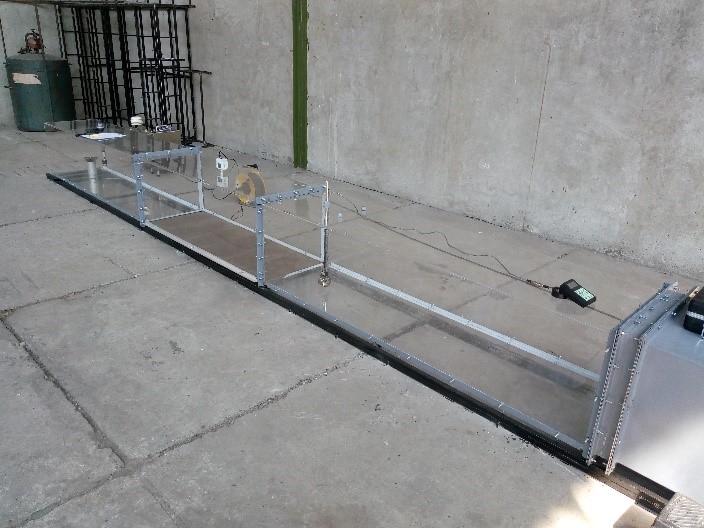
The project was preceded by laboratory testing of fly ash solidification with binding additives, examining the influence of mixture preparation methods on binding properties. Samples were prepared according to a procedure simulating field conditions, and tests were conducted in a specially constructed air tunnel.
The Mining Institute also carried out the technical inspection of the newly opened Čukaru Peki copper and gold mine near Bor, where the Institute participated in commissioning the mineral processing plant and facilities for disposal of mining waste and pyrite concentrate.
Scientific Research
Researchers at the Department actively contribute to the advancement of science and engineering through hundreds of published scientific and professional papers, registered patents, and participation in numerous scientific, technological, and innovation projects under the auspices of the relevant ministry. Their expertise is recognized through applied technical solutions and through initiating and organizing scientific and professional gatherings, notably the 16th Balkan Congress on Mineral Processing, held in Belgrade from June 17–21, 2015, with representatives from 26 countries.
Today, the Department for Mineral Processing and Design represents a highly competent entity, based on expertise, a modern management system, and recognized licenses, meeting the highest standards in its field.